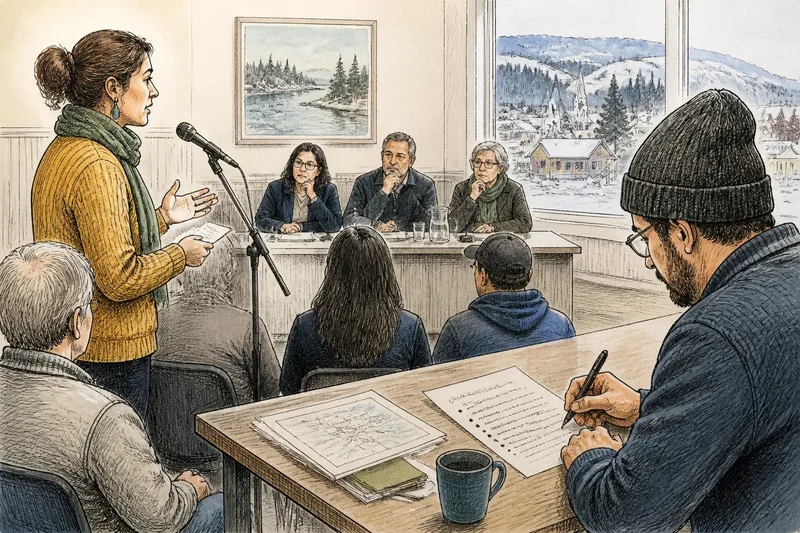
Why a Public Square Becomes a Civic Place
Why a public square becomes a civic place: see how ordinary gathering, exchange, and public expression turn shared ground into part of community life.
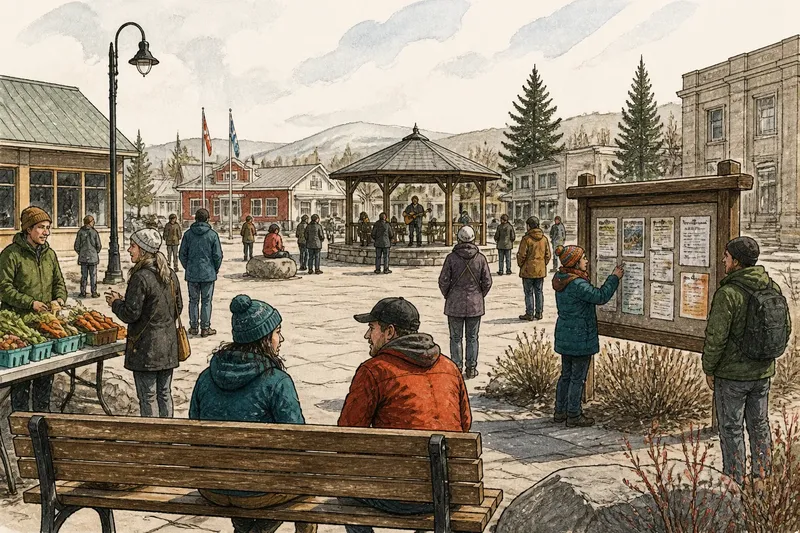
The common mistake is to call any open, paved space a civic place simply because it has benches or sits beside a municipal building. That shortcut misses the real cost: it makes the square’s public meaning seem fixed, when the people who use it may be changing what the space is for. A square becomes civic through repeated acts of gathering, exchange, and expression—not through its appearance alone.
In northern communities, a central square can be a pause between errands, a meeting point after work, a place to mark a public occasion, or a setting where residents make a concern visible. Those roles may overlap, but they do not arrive all at once. The square’s civic character takes shape as ordinary use meets shared memory and public life.
Ground for gathering
A square first offers a useful condition: people can be in the same place without needing to enter a private building or buy something. That openness matters in communities where familiar destinations may be spread out, indoor gathering places may have specific purposes, and weather can influence where people linger. Even a brief encounter—a greeting while waiting for a ride, a conversation after a shop visit—can make a central space part of a shared routine.
Being together, however, is not automatically civic participation. A crowd waiting for a bus is sharing space, but the gathering may have no public purpose. The civic quality emerges when people recognize that the place belongs to community life: they expect to encounter neighbors, exchange information, observe a public occasion, or be present while an issue is being expressed.
This distinction is subtle. A square need not host a formal meeting to matter, and a public event need not produce a decision. A place can become civic through the chance encounters and familiar presence that make later forms of public expression possible. It is a little like a kitchen table: the table does not create a family conversation, but it gives people a common surface around which one can happen.
Exchange beyond trade
Squares have often brought different kinds of exchange together. A market stall may involve buying and selling; a noticeboard may carry information; a conversation can pass along news that has not reached everyone through official channels. These exchanges are not identical, but they share a feature: people encounter something beyond their private routine.
That encounter can turn the square into a local point of reference. Someone who stops for vegetables may hear about a community gathering. A person crossing the space may notice that a familiar institution is being recognized or questioned. The square does not need to host every activity itself. Its civic role can include linking the everyday movements of a community to matters people hold in common.
Exchange also changes with the community. A square that once centered on trading goods might later be more closely associated with seasonal celebrations, informal meetings, or public notices. The old role does not necessarily disappear; it may become one strand in a thicker pattern of use. What matters is not preserving one idealized purpose, but noticing how the place connects people and shared concerns at a particular time.
Expression in public
Public expression gives a square a different kind of civic force. A gathering, display, ceremony, or peaceful demonstration makes an idea visible in a place other people already recognize. The point is not only what is said. The choice to assemble in shared space can itself signal that an issue is being brought into community life rather than kept within a private conversation.
Expression can be joyful, solemn, routine, or contentious. A celebration may affirm a shared identity; a remembrance may hold grief in public; a demonstration may call attention to a disagreement. These uses can sit alongside one another because a civic place is not defined by unanimous agreement. It is defined partly by the possibility that people will make different views visible in a common setting.
That possibility does not mean every use is welcomed equally or that every resident feels equally at ease. A square’s public meaning includes the question of who is present, who feels entitled to speak, and who tends to pass through without stopping. A place can be open in a physical sense and still feel unfamiliar or uninviting to some people. Recognizing that gap adds depth to the idea of civic space; it does not erase the value of shared ground.
Use changes the meaning
A square’s role shifts as the community around it shifts. A new meeting place, a change in local routines, or the arrival of a different generation may alter what people expect to find there. Seasonal conditions may also change how long people stay and which gatherings feel practical. The space remains recognizably the same, while its civic meaning gathers new associations.
Imagine a square where people once mainly crossed between a store and a public office. Over time, neighbors begin using the same spot to meet before community events, while a local group occasionally displays information there. The observable change is not necessarily a redesigned square: people now treat it as a place to encounter one another and notice shared concerns. That shift can make the square more civic without turning it into a formal institution.
Change can also be uneven. A place may be lively during a festival and quiet on an ordinary afternoon. It may serve as a meeting point for one group while remaining only a route to another. These differences do not make its civic role false; they show that public meaning is made through particular occasions and relationships, rather than installed once and for all.
What makes a square civic?
Does a square need a public building nearby?
No. A municipal building can connect a square with public affairs, but civic life can also gather around a market, transit stop, or familiar meeting point. The stronger clue is whether people use the space to encounter one another and matters they share.
Does a crowd make a place civic?
Not by itself. A crowd may be passing through or gathered for a private purpose, while a small recurring group can give a space a strong public role. Look at what the gathering connects people to, not just how many people are present.
Can a quiet square still matter?
Yes. A square may matter as a known meeting point, a route where people exchange local news, or a place used for occasional ceremonies. Its significance can be real even when public activity is intermittent.
Does disagreement weaken a square’s civic role?
Not necessarily. Disagreement can show that people regard the space as a place where shared concerns may be expressed, though access and comfort still matter. A civic role depends on public presence, not on everyone reaching the same view.
Reading the shared place
To understand a square, notice its pattern of use without treating one event as the whole story. Ask what brings people there, what kinds of exchange happen, and whether the space is associated with expression or shared remembrance. Consider whose routines are visible and whose may be harder to see. These observations help distinguish a civic place from a space that is merely central or attractive.
It also helps to separate the square’s role from the decisions made about it. A gathering may draw attention to an issue without deciding it; an official event may use the square without representing everyone who lives nearby. Public places can connect people to civic life, but they are not substitutes for the other ways communities listen, deliberate, and keep records.
Why a public square becomes a civic place is ultimately a question of relationship: how shared ground connects everyday movement with exchange, memory, and public expression. The most useful sign is not a particular feature or a constant crowd, but a recognizable pattern of people treating the place as part of community life. Notice what happens there across ordinary days as well as special occasions, and the square’s changing role becomes easier to see.