From Proposal to Decision: The Stages a Public Choice Can Pass Through
Follow a public proposal from first mention to recorded outcome, and tell whether it is open, under review, decided, or still waiting for action.
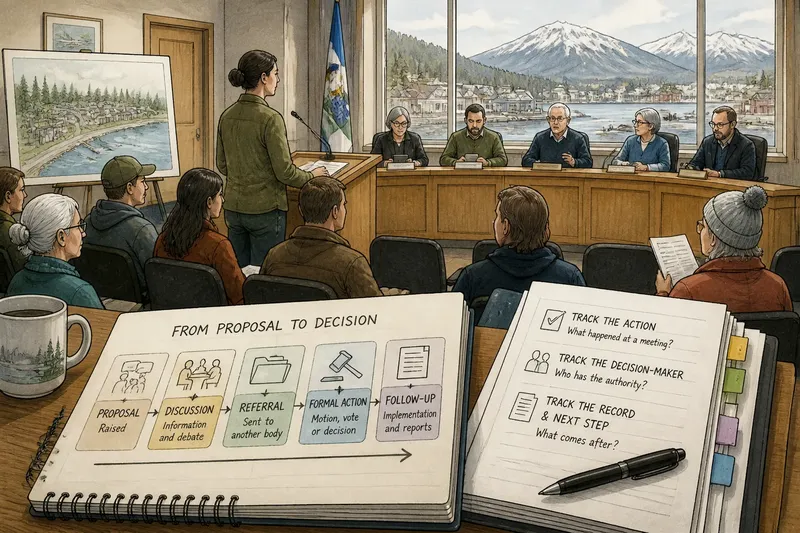
The common mistake with a public proposal is treating its first mention as a decision. That can lead residents to stop following an issue too soon—or to assume a choice is settled when officials have only agreed to discuss it. To track a public decision, look for what happened, who had authority to do it, and what the record says comes next.
A proposal might surface in a council meeting, a committee paper, a neighborhood request, or a staff report. From there, it could move through discussion, referral, formal action, and follow-up. Not every issue passes through every stage, and some routes overlap. The useful distinction is not a universal sequence but the status each public record supports.
Three ways to read status
When an issue appears to be moving, readers can use three practical approaches. Each answers a different question, so choose according to what you need to know.
- Track the action. Follow the verbs in agendas, minutes, and notices: proposed, referred, postponed, approved, denied. This suits someone who wants to know what officials did at a particular meeting. A verb alone is not enough, though; check who acted and whether the action was final or procedural.
- Track the decision-maker. Identify which body or official can make the relevant choice, then distinguish that authority from people who advise, review, or administer it. This suits issues that move between a committee, council, board, or staff department. A referral to another body is movement, not necessarily a decision on the proposal.
- Track the record and next step. Compare the meeting record with later notices, reports, or implementation updates. This suits a resident trying to understand what happens after a vote or recommendation. The minutes may record the formal action, while a later document explains whether it has been carried out.
Think of these approaches like checking a parcel: the action is the latest scan, the decision-maker is the destination, and the follow-up record shows whether it arrived. One clue rarely tells the whole story.
Proposal or discussion?
A proposal is an idea put forward for consideration. It may be submitted by a resident, introduced by an elected member, developed by staff, or included in a report. Its appearance on an agenda means the matter is scheduled for attention; it does not by itself mean that the responsible body has accepted the idea.
Discussion is the exchange that helps participants examine the proposal. Members may ask questions, hear a presentation, identify missing information, or debate possible options. Discussion can clarify the issue without settling it. A chair may close debate and call for a motion, or members may instead agree to seek more information or return to the matter later.
Look for the difference between an expression of support and an operative action. Comments such as “there is interest in this” describe a view. A motion, resolution, or recorded direction may establish what the body actually did, though the wording and authority matter. If the record says the item was received for information, that is not the same as approval of its contents.
Recommendation or decision?
A recommendation is advice to a person or body with the authority to decide. A committee might recommend that a council adopt a policy, for example, while the council has not yet considered or approved it. The recommendation can be an important milestone, but it should not be reported as the final outcome.
A decision is an action taken by the body or official empowered to make that choice. It might approve, reject, amend, defer, or refer a matter. Even a formal vote may settle only one part of a larger process: a policy decision can leave implementation details for staff, while a permit decision might be subject to a separate review route.
Say a resident sees a committee record recommending a new winter shuttle stop. The resident checks the next council agenda and finds the matter listed for consideration, then reads the minutes afterward: council approved the stop but asked staff to report back on service arrangements. The observable status is that the location was approved, while the operating details remain pending. This invented situation illustrates why a recommendation, a decision, and its follow-up should be tracked separately.
Records that settle status?
Does an agenda mean approval?
No. An agenda signals that an item is scheduled for a meeting, not that anyone has voted for it. Check the meeting record or a later official notice to learn what action followed.
Is a committee recommendation final?
Not unless the committee itself has authority to make the decision. If it is advising another body, look for that body’s later action before describing the proposal as approved or rejected.
What does “deferred” mean?
It generally means consideration was postponed, rather than the proposal being accepted or rejected. The record may identify a return date, a condition, or a request for more information; use that detail to find the next point of review.
Where should I check the outcome?
Start with the minutes or decision record for the body that considered the item, then check later agendas or official updates for follow-through. Names for records vary between communities, so search the local government’s meeting and records pages using the agenda item’s title or file number.
Pending, decided, or active?
“Pending” usually means a decision has not yet been made, but the reason can vary: the item may be awaiting a meeting, more information, another authority, or a later hearing. Avoid treating silence in one record as proof that the matter has ended. Look for an explicit disposition, a scheduled next step, or a later status notice.
“Decided” describes the formal outcome, but it does not necessarily mean the work is complete. An approved proposal may require funding, permits, procurement, or operational planning. A rejected proposal may still be revised and submitted again. Separate the decision itself from any remaining implementation or review work.
“Active” is a useful plain-language description when follow-up continues, but it may not be an official status label. State what is known instead: for example, that the council approved a policy and staff have been directed to prepare an implementation report. Specific wording is clearer than a broad label.
Choose a tracking approach
For a one-time meeting question, track the action: find the agenda item, then confirm the motion or outcome in the record. For an issue passed among committees and officials, track the decision-maker: note which body has authority and which actions are recommendations or referrals. For a matter with continuing work, track the record and next step: keep the decision document alongside later reports and notices.
Whichever approach fits, keep a small note with the issue’s exact name, the latest recorded action, the body responsible for the next decision, and any stated follow-up. Use the local label for the record and link or file reference if available. This makes it easier to distinguish a new discussion of the same issue from a separate proposal.
For the clearest account of a public decision, report both its status and its limits: what was formally decided, by whom, and what remains unresolved. That habit turns a trail of meeting records into a useful civic record without pretending every community follows the same route.